


The People Behind the Progress: How Liaison's Product Teams Build What Higher Ed Needs Now—And Next
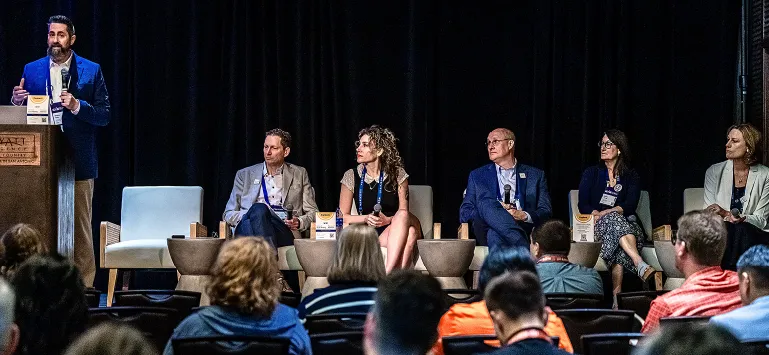
Liaison’s product teams turn higher education’s complex challenges into intuitive solutions. By listening closely to institutions and applicants, they ensure innovation is rooted in real needs, not roadmaps.
Key Takeaways
Liaison’s product teams turn higher ed’s growing complexity into clear, intuitive solutions by listening to the real needs of institutions and applicants.
Innovation is guided by a human‑centered philosophy: Technology only works when it’s shaped by insight from the people who use it.
Leaders across Liaison prioritize reliability, usability, mobile experiences, and responsible AI to meet rising expectations.
Behind every Liaison product, workflow improvement, and enhanced applicant experience, there are people listening closely. For 35 years, Liaison’s product teams have transformed the complexity of higher education into tools that help institutions and students move forward with clarity and confidence.
That work has always been rooted in one belief: Meaningful innovation begins with paying attention to the realities enrollment leaders face, not the priorities of a product roadmap.
Those realities today are unmistakably complex. Higher education is navigating volatility on multiple fronts, from shifting demographics and mounting financial pressures to accelerated technological change and rising expectations for personalization. Enrollment leaders can no longer rely on static, long-range planning; instead, they are recalibrating more frequently as past performance becomes a weaker predictor of behavior. range planning; instead, they are recalibrating more frequently as past performance becomes a weaker predictor of behavior.
An Intentional Evolution
At the same time, institutions are contending with burnout, turnover, and the challenge of protecting institutional knowledge amid constant change. These forces aren’t theoretical—they shape the work of every admissions team, program leader, and applicant who expects a more connected and intuitive experience.
Liaison’s product philosophy has evolved to meet those expectations. As highlighted in our 35 Year Insights Report, progress in higher ed requires clarity, coordination, and solutions that integrate seamlessly into institutional realities rather than adding new layers of complexity. That involves listening to institutions and applicants, soliciting their input as part of through feedback loop, prioritizing what influences outcomes, and iterating based on real-world results.
Over the decades, the pace and texture of this work have changed dramatically. Innovation cycles have accelerated, data has become central to decision making, and systems once siloed now need to communicate effortlessly across the enrollment ecosystem.
Expectations for intuitive UX and personalized student engagement have risen in parallel, reshaping what success looks like across the applicant journey. Yet through it all, Liaison’s grounding principle persists: Technology is only as valuable as the human insight that shapes it.
The People Behind the Work
“As VP of CAS Products, I focus on ensuring a great experience for all of the students using our platforms to find their next educational opportunity,” said Mike Margitich, who joined Liaison in 2009. “Easy to fill out mobile-friendly applications and tools make filling those applications out easier. I also keep an eye out for new markets where a Centralized Application Service (CAS) could help solve problems and reduce inefficiencies for students, school, and eventually the employers that are looking to hire those newly educated students.”
Higher education institutions and the technology they and their applicants depend on have changed a lot since Margitich began his tenure at Liaison, and those changes are reflected in the way his teams approach their work.
“As technology matures rapidly and our day-to-day technology experiences become richer, expectations are always going up for what our platform can do,” he said. “Ten years ago, most applicants were sitting comfortably at a desktop computer while filling out their application—now nearly 40% are doing it directly from their phones, meaning our software’s mobile experience has to be flawless. AI is, of course,making strong inroads into every industry, so we have an eye on how we can responsibly use it to make all of our processes better and more intelligent.”
Liaison Founder and CEO sets that tone, as he has for the past 35 years.
“The product philosophy we follow is ‘creating peace of mind with our products,’” he explains. “Our CEO has always been focused on this as our mission. If the product doesn’t make things easier for students, admissions officers, or in some of our newer markets, such as incredibly busy physicians who are trying to select their next cohort of residents, then we aren’t delivering on our promise.”
“A Deep Appreciation for Critical Reliability and Trust”
Sibu Thomas, VP, Sustaining Engineering and Application Support, has been at Liaison for 25 years, which gives him a particularly unique perspective on the evolution of higher ed institutions, people, and technology.
“When I joined Liaison in early 2001 as a Perl developer, higher education relied heavily on printed applications, mailed transcripts, and physical evidence stored in rooms full of paper. Over the years, I’ve seen that entire ecosystem evolve—first into digitized workflows, then into cloud-based platforms designed to operate at massive scale and under constant demand,” he said.
“What has remained surprisingly constant is the human purpose behind all of this. No matter how advanced the systems become, higher education is still about students meeting life-changing deadlines and institutions making thoughtful, mission-driven decisions. In moments of both routine operation and unexpected disruption, that responsibility remains the same—and it’s what continues to ground the work we do.”
Sibu is motivated by a consistent meaningful work, shared responsibility, and the knowledge that what he does directly impacts students and institutions when it matters most.
“That combination is rare,” he said. “And it’s why Liaison never felt like just another stop in my career.”
“Surfacing Candidates That Could be Great Fits”
As Margitich noted, “Truly valuable innovation makes the hard things feel easy.” He pointed to a recent initiative, Liaison ResidencyCAS, as an example of an innovation that benefits applicants as well as institutions eager to accept the right candidates,
“In medical residency , one of our newest markets, we worked across many of our product teams and developed a data-science backed method for quickly surfacing candidates that could be great fits for your institution but might have otherwise been missed with traditional applicant pool filtering methods,” he explained. “This gave the right candidates a shot at being seen by the perfect program for them, especially when some of their traditional metrics, such as test scores, may fail to tell the whole story.”
To hear more from the people behind the progress at Liaison, read 35 Years of Navigating Change in Higher Education: Strategic Insights on What’s Next for Institutions, Students, and the People Who Support Them.