


Liaison Founder and CEO George Haddad Reflects on 35 Years Serving the Higher Ed Community
Our work has never been about technology for its own sake. It has been about helping institutions function more effectively in service of students and the professions they support.
Marking 35 years in higher education invites reflection, but not the kind that settles easily. This is not a time for looking back simply to acknowledge longevity or milestones. It is a moment that asks something more demanding: perspective.
Higher education has always lived with change, but the current environment feels different in both scale and duration. Demographic contraction, political volatility, public skepticism about the value of a degree, and rapid technological acceleration are no longer episodic challenges. They are overlapping realities that institutions must navigate simultaneously, often with fewer resources and less margin for error.
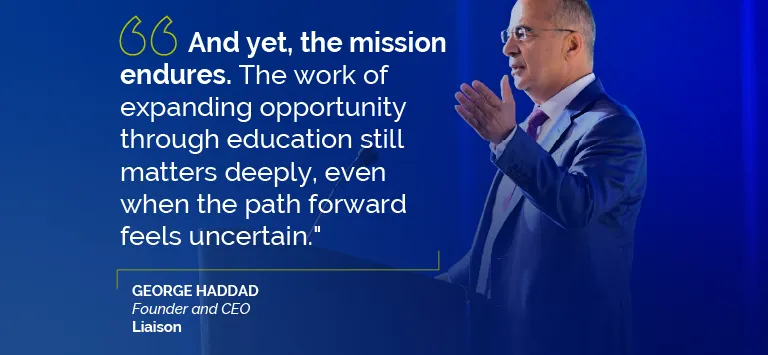
And yet, the mission endures. The work of expanding opportunity through education still matters deeply, even when the path forward feels uncertain.
"We Stay Focused on Outcomes Rather Than Process"
Over the years, I have learned that times like this require leaders to return to first principles. Early in my career, a mentor asked me a question that continues to shape how I approach leadership: "What do you want the outcome of this experience to be?" It is a deceptively simple question, but a demanding one. It forces clarity. It asks us to distinguish between activity and purpose, between motion and direction.
That distinction has guided Liaison from the beginning.
Our work has never been about technology for its own sake. It has been about helping institutions function more effectively in service of students and the professions they support. When we stay focused on outcomes rather than process, we make better decisions. Our innovation becomes more disciplined. Our partnerships become more durable. Our role becomes clearer.
Looking back across 35 years, what stands out most is not a single product or moment, but a pattern of learning. Like many organizations that have endured, we tried things that worked and things that did not. Some ideas arrived before the field was ready. Others taught us the limits of straying too far from our core purpose. Each experience, successful or not, sharpened our understanding of who we are and what we are here to do.
"Progress Requires Judgment, Restraint, and Deep Respect"
The real risk to institutions and organizations like ours is not missteps. It is complacency.
Progress slows when curiosity fades. When past success is treated as sufficient proof for future relevance, institutions lose the capacity to adapt. In a field as consequential as higher education, that loss carries real consequences for students, families, and communities. Stewardship requires a willingness to keep asking hard questions, especially when the answers are uncomfortable or incomplete.
This is why questions matter so much. Many of the most meaningful changes in our work did not begin with solutions, but with careful inquiry. What problem are we actually trying to solve? Who is this serving? What trade-offs are we making, and are they aligned with our values? Answers move us forward, but questions keep us honest.
As we look ahead, technology will undoubtedly play a significant role in shaping what comes next. But tools alone will not determine success. What matters more is how thoughtfully they are applied, how clearly they are governed, and how well they support the people doing the work. Progress requires judgment, restraint, and a deep respect for the human systems that sustain institutions over time.
At its core, our work has always been about reducing unnecessary complexity, lowering barriers to access, and creating pathways to opportunity. Doing that well depends on trust that is built through consistency, care, and the shared vision of long-term partnership.
"What Focuses My Attention Is the People We Serve"
What concerns me most, and what focuses my attention, is the people we serve. The professionals carrying the day-to-day responsibility for enrollment success under sustained and increasing pressure. The institutional leaders navigating relentless staff turnover and resource constraints. The applicants placing their hopes in systems that must work fairly and transparently. If we fail to take care of people, no amount of innovation will deliver our desired outcomes.
Stewardship, whether of an institution or a company, requires the ability to create and nurture systems, relationships, and practices resilient enough to endure change and flexible enough to evolve. That kind of work rarely produces quick wins, but it does produce stability, trust, and meaningful progress over time.
What gives me confidence today is not certainty about what comes next, but the quality of the people engaged in the work. Across higher education, I see professionals who are thoughtful, resilient, and deeply committed to serving students well, even under sustained pressure. Their insights are shaped less by prediction than by lived experience, and less by urgency than by care. That kind of perspective cannot be automated or replaced.
My hope is that this reflection contributes to a steadier conversation about the future of higher education, one grounded in clarity, responsibility, and respect for the complexity of the systems we steward. The challenges ahead are real, and they will not be solved quickly. Still, the work remains meaningful. When we stay focused on outcomes, on people, and on long-term trust, progress remains possible through consistent effort, thoughtful decisions, and durable partnerships.