


How to Adapt to Disruption Without Losing Your Identity
Market pressures, technological change and shifting learner expectations will keep demanding adaptation. Institutions that view change as a cyclical opportunity rather than a disruption will stay relevant.
Table of Contents:
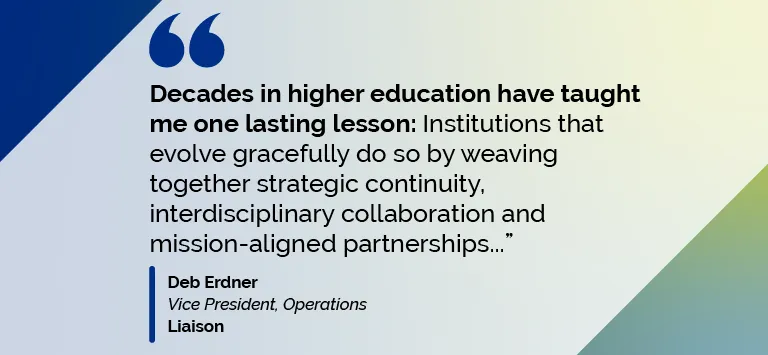
Decades in higher education have taught me one lasting lesson: Institutions that evolve gracefully do so by weaving together strategic continuity, interdisciplinary collaboration and mission‑aligned partnerships. As demographics shift and technology advances, institutions face rising expectations for flexibility and lifelong learning.
At the same time, global competition, economic uncertainty and shifting labor markets continue to reshape how colleges define their role. This convergence marks an inflection point, and higher education leadership that recognizes this moment can guide institutions into a more resilient future.
One of the most visible transformations involves how institutions structure knowledge and departments. Over the years, many campuses have moved away from rigid departmental silos toward more integrated academic models.
Experimenting While Staying Grounded
At the university where I serve on the board, the decision to merge its engineering and business schools reflected an understanding that today’s workforce values the capacity to navigate complex, cross‑disciplinary challenges.
That kind of restructuring doesn’t happen overnight. It reflects long-term leadership that honors existing strengths while anticipating emerging needs. The result is a more robust educational environment that better serves students, faculty, and employers alike.
Technology has played a pivotal role in reshaping how education is delivered and experienced. The abrupt shift to online learning during the pandemic underscored the necessity and potential of digital transformation in higher education.
What began as an emergency measure has matured into a full suite of options: in‑person, hybrid and fully online. These modalities give learners, whether working adults, international students, or first‑generation college attendees, greater flexibility and access.
Two‑thirds of adult learners now study online, compared to just 4% of traditional undergraduates, highlighting how online learning has become essential for reaching returning students.
As the nature of higher education evolves, so has the role of vendors, service providers and institutional partners. The old paradigm framed these as transactional relationships: An institution paid for a service, a vendor delivered and the exchange ended.
That dynamic has given way to a more collaborative mindset grounded in shared mission. In many cases, institutions now work with partners as co‑pilots.
This mirrors the difference between a startup vs. established company mindset while incorporating the essential elements of each: the agility, responsiveness, and innovation of a startup balanced with the longevity, scale, and institutional memory of a mature organization. Institutions that embrace this relationship can experiment with new models while staying grounded in institutional mission and values.
Viewing Change as an Opportunity
Across these shifts, we can see some patterns emerging for sustainable adaptation:
- Cross‑functional collaboration strengthens response capacity | Breaking down departmental silos and creating shared governance enables prompter decision making and broader buy in.
- Flexible learning modalities expand access and equity | Through hybrid and online formats, institutions meet learners where they are and make higher education more inclusive and resilient.
- True partnership transcends transactions | When institutions and partners align on mission and outcomes rather than deliverables, innovation scales more smoothly.
- Leadership fosters stability and openness to change | Sustained growth depends on steady vision, data‑informed decisions, and readiness to experiment thoughtfully.
For institutions looking to the future of higher education, this history offers a clear principle: Long-term leadership means building systems that adapt without losing identity.
The above trends illustrate how agility and continuity can coexist. Some institutions treat these as competing impulses, but they don’t have to be. By combining respect for legacy with openness to new models, colleges can evolve without sacrificing core values.
Continuing this trajectory matters more than ever for innovation in higher education. Market pressures, technological change and shifting learner expectations will keep demanding adaptation.
Institutions that view change as a cyclical opportunity rather than a disruption will stay relevant. Through strategic collaboration, flexible learning options and mission‑aligned partnerships, higher education can meet the needs of tomorrow’s learners while preserving the values that define it.